Blackjack Rules 2026 — Complete Beginner-to-Advanced Guide
Blackjack is the only major casino game where player skill meaningfully affects outcomes. With perfect basic strategy on standard rules, the house edge drops to roughly 0.5% — the lowest in any casino, online or land-based. This complete rules guide covers every blackjack rule a Malaysian player needs to know: standard hand values, dealer behaviour, doubling, splitting, insurance, surrender, the rule variants that matter, and how the dealer's upcard drives your every decision. Walk away ready to play any live or RNG blackjack table on the leading online casino Malaysia platform with mathematically optimal decisions.
What This Guide Covers
- The objective — beating the dealer, not getting 21
- Card values and how hands are counted
- Standard gameplay flow — deal, decisions, dealer action
- Player actions — Hit, Stand, Double, Split, Surrender
- Dealer rules — Stand on 17, Hit on Soft 17
- Payouts and the critical 3:2 vs 6:5 rule
- Blackjack variants — Infinite, Free Bet, Double Exposure
- Basic strategy — the rules that drop house edge to 0.5%
- FAQ — blackjack rules questions answered
The Objective — Beating the Dealer, Not Getting 21
The single most common misconception about blackjack: the objective is not to get 21. The objective is to beat the dealer's hand without exceeding 21. You can win with a hand total of 12 if the dealer busts. You can lose with a hand total of 20 if the dealer hits 21. The "21" framing distracts new players from the actual decision framework, which is always relative to the dealer's upcard.
This relative framing matters because basic strategy decisions all depend on what the dealer is showing. Hit 16 vs dealer 7 (because the dealer likely makes 17-21). Stand on 16 vs dealer 6 (because the dealer is statistically likely to bust). Every decision optimises your expected win against the specific dealer upcard.

Card Values and How Hands Are Counted
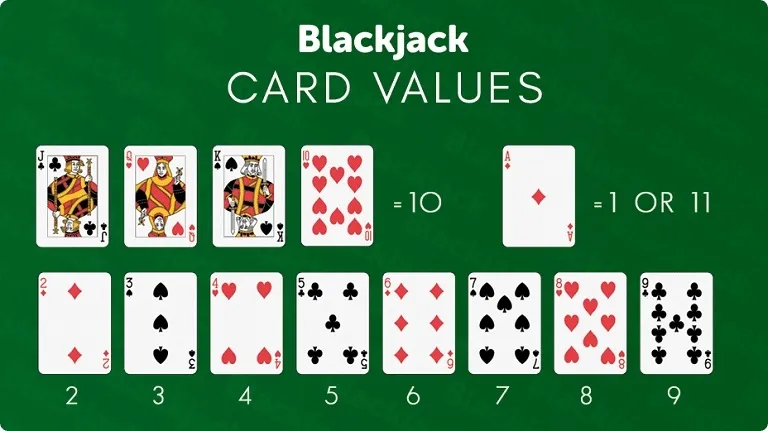
Every blackjack card has a fixed point value with one critical exception — the Ace.
| Card | Value | Notes |
|---|---|---|
| 2 through 10 | Face value (2-10) | Straightforward |
| Jack, Queen, King | 10 | All face cards count as 10 |
| Ace | 1 or 11 | Player's choice — soft vs hard hand |
Hard Hands vs Soft Hands
A "soft" hand contains an Ace counted as 11. A "hard" hand has no Ace, or contains an Ace forced to count as 1 to avoid busting. The distinction matters because soft hands cannot bust on a single hit — making basic strategy more aggressive on soft hands than hard hands of the same total.
- Soft 17 (A 6): If you hit and draw a 5, the Ace becomes 1 and you have hard 12 — no bust risk.
- Hard 17 (10 7): If you hit and draw a 5, you have hard 22 — bust.
The same total (17) commands very different strategic decisions depending on whether it is soft or hard.
Standard Gameplay Flow — Deal, Decisions, Dealer Action
A standard live blackjack hand follows the same flow on every Malaysia-facing table:
- Players place bets in the betting circle before the deal.
- Dealer deals two cards to each player, face up, going clockwise.
- Dealer deals their own two cards — one face up (the "upcard"), one face down (the "hole card").
- Players act in turn, deciding to Hit, Stand, Double, Split, or Surrender based on their hand and the dealer's upcard.
- Dealer reveals the hole card after all players have acted.
- Dealer plays the hand according to fixed rules (typically Stand on 17, Hit on Soft 17 depending on the variant).
- Hands compare: closer to 21 without busting wins. Equal totals are pushes (no win, no loss).
Player Actions — Hit, Stand, Double, Split, Surrender
Hit
Take another card. Available at any time before reaching 21 or busting. You can hit multiple times.
Stand
Keep your current total. Your hand is locked.
Double Down
Double your bet, receive exactly one more card, then automatically stand. Some tables restrict doubling to totals of 9, 10, or 11 only ("Double on 10/11" rules) — others allow doubling on any two-card total ("Double any two cards"). Look for the more permissive rule.
Split
If your two cards are the same value (two 8s, two Kings, etc.), split them into two separate hands with separate bets. Some tables limit splitting to one round; others allow re-splitting up to 4 hands. Splitting Aces is special — you typically get one card per Ace and cannot hit again. Splitting same-value face cards (K-K, Q-Q) is almost always wrong — you already have 20, a strong hand. Splitting 10s breaks one good hand into two mediocre hands.
Surrender
Give up the hand immediately and receive half your bet back. Available on most live blackjack tables before any other action. Surrender is mathematically correct on a small number of specific hands (Hard 16 vs dealer 9, 10, A; Hard 15 vs dealer 10). Use it on those hands; ignore it otherwise.

Dealer Rules — Stand on 17, Hit on Soft 17
The dealer has no decisions — they follow fixed rules every hand. Two rule variants matter, and the difference affects your basic strategy.
S17 (Stand on All 17s) — Better for the Player
The dealer stands on all totals of 17 or higher, including soft 17 (A 6). House edge with basic strategy: ~0.45%. This is the variant to prefer.
H17 (Hit on Soft 17) — Worse for the Player
The dealer hits soft 17 (A 6 totalling 17) until reaching a hard 17 or higher. This rule benefits the dealer because soft 17 is a weak hand, and hitting it often improves it. House edge with basic strategy: ~0.65%. Avoid H17 tables when S17 is available.
Most Evolution Gaming live blackjack tables on the Live Casino Malaysia hub use S17 by default. Always check the table rules before sitting down.
Payouts and the Critical 3:2 vs 6:5 Rule
Standard payouts:
- Win: 1:1 (you bet RM 10, win RM 10 plus your RM 10 back)
- Push (tie): Your bet returned, no winnings
- Blackjack (Ace 10-value card on first two cards): 3:2 (you bet RM 10, win RM 15)
- Insurance (when dealer shows Ace): 2:1 if dealer has blackjack
The 3:2 vs 6:5 Critical Rule
Some blackjack tables pay 6:5 on blackjack instead of 3:2. This sounds minor but adds 1.4% to the house edge — turning a 0.5% game into a 1.9% game. Never play 6:5 blackjack. Always verify the table pays 3:2 on natural blackjacks before sitting down. The payout rule is displayed on the table felt and in the table info panel.
Blackjack Variants — Infinite, Free Bet, Double Exposure
Infinite Blackjack
Unlimited players can play the same dealer hand simultaneously. Useful for crowded tables or when you want to play alongside friends. Rules are otherwise standard.
Free Bet Blackjack
The casino pays for your double-down on 9, 10, or 11 (and pays for splits of certain pairs). Sounds player-favourable but compensates by pushing on dealer 22 instead of busting — raising house edge slightly. Skip this variant.
Double Exposure
The dealer's hole card is shown face-up alongside the upcard. Hugely player-favourable on its face — but compensates by paying blackjacks 1:1 instead of 3:2 and pushing tied hands to the dealer. Net effect: similar house edge to standard blackjack, with very different decision strategy.
Speed Blackjack
Faster-paced rounds (10-15 second decisions instead of 25-30). Same rules and math as standard blackjack — just compressed. Good for high-volume play.
Basic Strategy — The Rules That Drop House Edge to 0.5%
Basic strategy is a mathematically derived set of rules telling you the optimal action for every player hand against every dealer upcard. Following basic strategy on a standard 3:2 S17 table reduces the house edge from a default ~2% to ~0.5%. Here are the core decision rules.
Hard Hand Strategy
- 5-8: Always hit.
- 9: Double vs dealer 3-6; hit otherwise.
- 10: Double vs dealer 2-9; hit otherwise.
- 11: Double vs dealer 2-10; hit vs Ace.
- 12: Stand vs dealer 4-6; hit otherwise.
- 13-16: Stand vs dealer 2-6; hit vs dealer 7-A.
- 17 : Always stand.
Soft Hand Strategy (Hand contains Ace counted as 11)
- A-2 / A-3: Double vs dealer 5-6; hit otherwise.
- A-4 / A-5: Double vs dealer 4-6; hit otherwise.
- A-6: Double vs dealer 3-6; hit otherwise.
- A-7 (soft 18): Stand vs dealer 2, 7, 8; double vs 3-6; hit vs 9, 10, A.
- A-8 / A-9: Always stand.
Pair Splitting Strategy
- Always split: Aces, 8s.
- Never split: 4s, 5s, 10s/face cards.
- 2s, 3s: Split vs dealer 2-7; hit otherwise.
- 6s: Split vs dealer 2-6; hit otherwise.
- 7s: Split vs dealer 2-7; hit otherwise.
- 9s: Split vs dealer 2-6 and 8-9; stand vs 7, 10, A.
Memorize these rules over your first 100 hands and you will play near-optimal blackjack indefinitely. For deeper strategy detail see our How to Play Blackjack guide.
Frequently Asked Questions About Blackjack Rules 2026
What is the house edge in blackjack with basic strategy?
Approximately 0.5% on a standard 3:2 S17 table when basic strategy is followed perfectly. This is the lowest house edge in any major casino game, online or land-based. On an H17 table the figure rises to about 0.65%; on a 6:5 table it rises to about 1.9%. Always play 3:2 S17 when available.
Should I take insurance when the dealer shows an Ace?
No. Insurance is a side bet that the dealer has blackjack, paying 2:1 if correct. The actual probability of the dealer having blackjack given an Ace upcard is 30.77% — making insurance a 5.88% house edge bet, dramatically worse than the main game. Decline insurance every time unless you are counting cards (which is impractical on shuffled live tables).
What is the difference between a "soft" and "hard" hand?
A soft hand contains an Ace counted as 11 — it cannot bust on a single hit. A hard hand has no Ace, or has an Ace forced to count as 1. The same total (e.g. 17) commands different strategy depending on whether it is soft or hard. Soft hands are played more aggressively because of their bust immunity.
Can I count cards in live online blackjack?
Theoretically yes, but practically no. Most online live blackjack tables use 6-8 deck shoes with the shoe reshuffled at the 50-60% penetration point. Card counting edges only emerge at deeper penetration. The math does not work for online play. Stick to basic strategy — it captures 95% of the available edge against the house.
Why do basic strategy charts vary slightly between sources?
Because rule variants differ. S17 vs H17, 3:2 vs 6:5, double-after-split allowed vs not, surrender allowed vs not — each variant shifts a few decisions. The core 80% of basic strategy is identical across all variants; the edge cases shift. Use a strategy chart matched to the specific variant you are playing.
Is live dealer blackjack better than RNG blackjack?
The math (house edge) is identical on properly licensed games. Live dealer offers physical verifiability and atmosphere; RNG offers faster pacing and lower minimum bets. For pure return optimisation, both work equally well. Most Malaysian players prefer live dealer for the experience. Browse all blackjack tables at the blackjack hub.
Can I claim the welcome bonus playing blackjack?
Yes — the Live Casino 100% Welcome Bonus applies to live blackjack tables. Note that blackjack contributes 10-20% to bonus wagering (versus 100% for slots), so wagering clearance takes longer. Plan your session volume accordingly. Full terms on the Promotion hub.
Why VVCasino Offers Malaysia's Best Blackjack Tables
VVCasino — the leading live casino Malaysia platform — runs blackjack tables from Evolution Gaming (industry-standard), Pragmatic Play Live (mobile-first), and SA Gaming (Asian dealers). Most tables use 3:2 S17 rules — the player-favourable standard. Minimum bets from RM 5 on entry-level tables. Beyond blackjack, play 1,500 slots via our Online Slots Malaysia hub and full sportsbook coverage at the Sports Malaysia hub.
For related reading, see How to Play Blackjack, How to Play Baccarat, Baccarat Rules, and Roulette Rules.
Master the Rules. Play the Math. Win the Long Run.
Blackjack at 0.5% house edge — the lowest in any casino. Live tables from Evolution, Pragmatic, and SA Gaming with RM 5 minimum bets. Claim up to MYR 2,880 welcome bonus and play with the rules you now know.
Register & Play Blackjack Browse Blackjack Tables