Parlay Bet 2026 — Multi-Leg Strategy, Math & Risk Guide
Parlay betting is the most popular bet type among Malaysian football bettors — and the most misunderstood. A 5-leg parlay at 2.0 odds per leg pays 32:1. Sounds incredible. The actual hit probability is 3.125%. Most parlay bettors lose money long-term because they focus on the headline payout multiple and ignore the cumulative win probability. This complete guide explains exactly how parlays work mathematically, where they offer genuine value, where they trap bettors, and the disciplined framework for using parlays as a small variance-upside slice of a serious betting portfolio on the leading online betting Malaysia platform.
What This Guide Covers
- What a parlay bet actually is
- The math — why 5-leg parlays look better than they are
- Leg count tradeoff — 2 legs vs 5 legs vs 10 legs
- How parlay odds multiply across legs
- Asian parlays — partial wins and half-stake rules
- When parlays offer genuine value vs when they trap
- Bankroll rules for disciplined parlay betting
- FAQ — parlay betting questions answered
What a Parlay Bet Actually Is
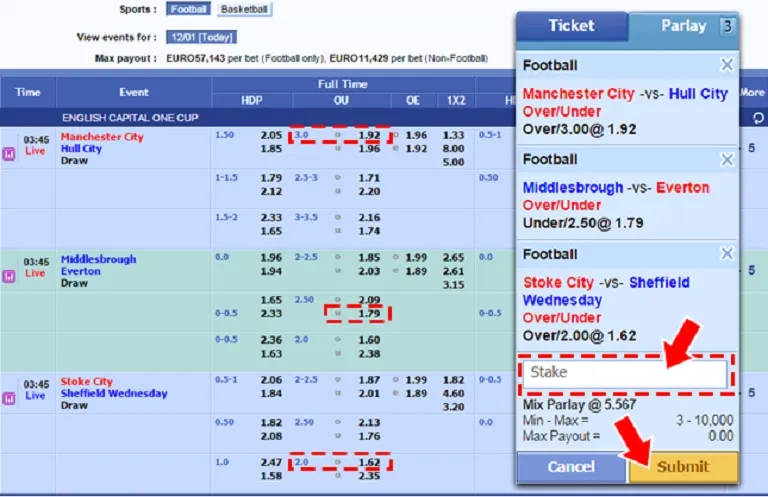
A parlay bet (also called accumulator, combo bet, or "mix parlay" on Asian sportsbooks) combines multiple individual bets ("legs") into a single wager. All legs must win for the parlay to pay out; if any single leg loses, the entire parlay loses. The payoff is the multiplication of all leg odds — which produces dramatic potential payouts but proportionally lower hit rates.
The structural appeal is obvious. A 5-leg parlay where each leg pays 2.0 (50/50 odds) returns 32x your stake if all hit. RM 10 becomes RM 320. The reality check: each leg has a 50% hit rate, so the joint probability of all 5 hitting is 0.5⁵ = 3.125%. Over 100 such 5-leg parlays at fair odds, you'd hit roughly 3 times and lose 97 times — netting roughly zero (96 losses × RM 10 vs 3 wins × RM 310). The math is fair. The variance is enormous.

The Math — Why 5-Leg Parlays Look Better Than They Are
The fundamental parlay math comes from probability multiplication. If each leg has an independent win probability P(leg), then:
P(parlay wins) = P(leg₁) × P(leg₂) × P(leg₃) × ... × P(legₙ)
Here's what that looks like across different leg counts assuming each leg has 50% win probability and pays 2.0 odds:
| Legs | Hit Probability | Payout Multiplier | Fair Expected Value |
|---|---|---|---|
| 2 | 25.00% | 4.0x | 1.000 (break-even at fair odds) |
| 3 | 12.50% | 8.0x | 1.000 |
| 5 | 3.13% | 32.0x | 1.000 |
| 7 | 0.78% | 128.0x | 1.000 |
| 10 | 0.098% | 1024.0x | 1.000 |
At fair odds with no sportsbook margin, parlays have zero expected value advantage over single bets — same long-run return, dramatically higher variance. The reality is worse: sportsbooks apply margin to each individual leg, and the margin compounds across legs in a parlay. A 3% margin per leg compounds to 16% combined margin on a 5-leg parlay. This is why parlay margins on most Malaysia-facing sportsbooks effectively sit at 3-8% per leg combined.
Leg Count Tradeoff — 2 Legs vs 5 Legs vs 10 Legs
The right parlay leg count depends on your specific betting goals. Different leg counts produce dramatically different risk/reward profiles.
2-3 Leg Parlays (Conservative)
2-3 leg parlays have meaningful hit rates (10-25%) and modest payouts (4-8x). These work as small upgrades over single bets when you have high confidence on a small number of correlated selections. The combined margin is manageable (5-10% effective). Recommended for serious parlay players.
4-6 Leg Parlays (Moderate)
4-6 leg parlays sit in the middle — meaningful payouts (15-60x) but low hit rates (1.5-6%). The combined margin builds (10-25% effective), making these mostly entertainment bets rather than expected-value plays. Use sparingly.
7 Leg Parlays (Lottery Tickets)
7 leg parlays are essentially lottery tickets — massive theoretical payouts (100x ) at vanishingly small hit rates (under 1%). The compound margin (25% effective) means almost every player loses money on these long-term. Acceptable only as small recreational bets representing 1-5% of your monthly betting budget.
How Parlay Odds Multiply Across Legs
For decimal odds, parlay payout multipliers are calculated by simple multiplication. Example with three legs:
- Leg 1: Manchester United -1.5 AH @ odds 2.10
- Leg 2: Real Madrid vs Barcelona Over 2.5 @ odds 1.90
- Leg 3: Arsenal to win @ odds 1.80
Combined parlay odds: 2.10 × 1.90 × 1.80 = 7.18
A RM 10 stake on this 3-leg parlay returns RM 71.80 if all three legs hit (RM 61.80 profit RM 10 stake). The implied joint probability is 1/7.18 = 13.9%. Compare that to the individual leg probabilities (~47.6%, ~52.6%, ~55.6% respectively) which multiply to 13.9% — confirming the parlay odds reflect joint probability accurately at fair pricing.
Asian Parlays — Partial Wins and Half-Stake Rules
Asian-market sportsbooks (SBOBET, WBET, SABA Sports, CMD368) offer a distinctive parlay structure with partial-win mechanics that European/American books don't have. The key rules:
Quarter Lines in Parlays
If you include an Asian Over/Under quarter line (e.g. Over 2.25) in your parlay, that leg can produce a half-win or half-loss depending on the actual goal total. This propagates through the parlay calculation — a half-loss on one leg effectively makes that leg's odds equal to 1.0 (push) while the other legs still multiply normally.
Push Legs
If any leg pushes (refunded), the parlay calculation removes that leg from the multiplication. A 5-leg parlay where 1 leg pushes becomes a 4-leg parlay at the corresponding payout. The other legs must still all hit for the parlay to win.
Voided Legs
If a match is postponed or voided, that leg is removed from the parlay and the parlay recalculates as if it had fewer legs. The remaining legs must all hit. Browse current available parlays at the Sports Malaysia hub.
When Parlays Offer Genuine Value vs When They Trap
Genuine Value Opportunities
- Correlated outcomes across the same match. Some sportsbooks allow same-game parlays where outcomes are positively correlated (e.g. team to win over 2.5 goals). When correlation exists, the combined odds underestimate the joint probability, creating value.
- Same-day high-confidence picks. If you have 2-3 picks at strong analytical conviction (60% win probability vs market-implied 50%), a 2-3 leg parlay captures the multiplied edge across your high-confidence selections.
- Boosted parlay promotions. Some sportsbooks offer odds-boost promotions on specific parlays. Read the T&Cs carefully but when the boost exceeds the standard parlay margin, genuine positive expected value exists.
Parlay Traps to Avoid
- Mixing low-confidence legs to inflate payout. Adding a 6th uncertain leg to make the parlay "look bigger" multiplies your variance and reduces your expected value.
- Chasing previous losses with bigger parlays. The "I'll win it all back" parlay is the single most expensive habit in sports betting.
- Heavy favourites parlay strategies. Combining many 1.20-1.30 odds favourites into a parlay accumulates margin quickly while still producing low hit probability due to compound risk.
Bankroll Rules for Disciplined Parlay Betting
5 Bankroll Rules for Parlay Betting
- Cap parlay exposure at 10-20% of total sports betting bankroll. The remaining 80% goes to single bets and Asian handicap markets. Parlays are the variance-upside slice, not the core.
- Bet 0.5-1% of bankroll per parlay. Smaller than single bets because parlay variance is higher. A 100-parlay sample needs to absorb 50 consecutive losses without crushing your bankroll.
- Prefer 2-3 leg parlays. Hit rates remain meaningful (10-25%), margins stay manageable, and high-confidence multi-leg correlation can produce real value.
- Avoid 7 leg parlays except as small entertainment bets. The combined margin destroys long-term expected value. Treat these as lottery tickets, not investments.
- Use welcome bonus capital for parlay experimentation. The Sports 100% Welcome Bonus matches your first deposit — effectively doubling your initial bankroll specifically for the parlay learning curve.
Frequently Asked Questions About Parlay Bet Malaysia 2026
What is a parlay bet in football?
A parlay (mix parlay) bet combines multiple football bets ("legs") into a single wager. All legs must win for the parlay to pay out. The payoff is the multiplication of all leg odds — dramatic potential payouts but proportionally lower hit rates. A 5-leg parlay where each leg pays 2.0 returns 32x your stake at a 3.125% hit rate.
How many legs should I include in a parlay?
2-3 legs for serious betting, 4-6 legs for moderate entertainment betting, 7 legs only as small recreational bets. The compound margin builds quickly with each additional leg. Lower leg counts have meaningfully higher hit rates and lower combined margins, producing better long-term expected value.
Can I have a parlay with the same match's outcomes?
On Asian sportsbooks like SBOBET and WBET, "Same Game Parlay" or combo bets within the same match are typically restricted or have different odds calculations to account for correlation between outcomes. Check the bet slip terms before placing. Standard parlays combine outcomes across different matches.
What happens if one of my parlay legs is postponed or voided?
The voided leg is removed from the parlay and the parlay recalculates as if it had fewer legs at the corresponding lower payout multiplier. The remaining legs must all hit for the parlay to win. A 5-leg parlay with one voided leg becomes a 4-leg parlay calculation.
Is parlay betting profitable long-term?
It can be, but only with strict discipline. The compound margin across legs makes most parlays negative expected value at market odds. Profitable parlay betting requires identifying correlated outcomes, high-confidence multi-leg picks, or odds-boost promotions where the boost exceeds the margin. Most casual parlay bettors lose money over time because they focus on payout headlines rather than expected value.
Which sportsbook offers the best parlay odds in Malaysia?
SBOBET has the tightest individual leg margins on tier-1 European football, which translates to the best parlay value because individual leg margins compound. WBET and SABA Sports are competitive. All three are accessible through a single wallet on the leading online betting Malaysia platform.
Can I claim a welcome bonus and place parlay bets?
Yes — parlays count toward Sports welcome bonus wagering. The Sports 100% Welcome Bonus matches your first sports deposit, with the full welcome track capping at MYR 2,880. Note that minimum-odds requirements may apply during bonus wagering — typically each leg must be at least 1.50-1.80 odds to count.
Why VVCasino Has Malaysia's Best Parlay Infrastructure
VVCasino — the premier online gambling Malaysia destination — consolidates SBOBET, WBET, and SABA Sports into a single wallet, letting you mix parlay legs across providers in a single ticket. Live in-play parlay placement, Asian quarter-line parlays with partial-win mechanics, and the tightest individual leg margins on tier-1 European football. Browse all sports markets at the Sports Malaysia hub. Beyond sports, play 1,500 slots via our Online Slots Malaysia hub and 250 live dealer tables at the Live Casino Malaysia hub.
For related reading, see Sports Betting Guide, Sports Betting Odds, How to Bet on Sports, Over Under Bet, Correct Score, and How to Win at Sports Betting.
Multi-Leg Math. Multi-Provider Wallet. Disciplined Risk.
Parlay bets across SBOBET, WBET, and SABA Sports in a single ticket. Asian quarter lines with partial-win mechanics. Tightest tier-1 margins on the Malaysian market. Claim up to MYR 2,880 welcome bonus today.
Register & Build Parlay Browse Football Markets