Baccarat Rules 2026 — Complete Beginner-to-Advanced Guide for Malaysian Players
Baccarat is the lowest-house-edge table game in the casino — and the simplest to play correctly. The Banker bet carries a house edge of just 1.06%, lower than every blackjack variant, lower than every roulette variant (including French Roulette with La Partage), and lower than craps pass line. Yet baccarat is also one of the most misunderstood games among Malaysian casino players, with myths about "scorecards" and "patterns" that have no mathematical basis. This complete rules guide covers every aspect of baccarat: card values, drawing rules, the three main bet types, payouts, side bets to avoid, and where each variant fits in a serious live casino rotation on the leading live casino Malaysia platform.
What This Guide Covers
- The objective — Banker or Player closest to 9
- Card values and hand totaling rules
- Standard gameplay flow
- Third card drawing rules
- The three main bets — Banker, Player, Tie
- Payouts and the 5% commission
- Side bets to avoid — Pair, Big/Small, Dragon Bonus
- Baccarat myths busted
- FAQ — baccarat rules questions answered
The Objective — Banker or Player Closest to 9
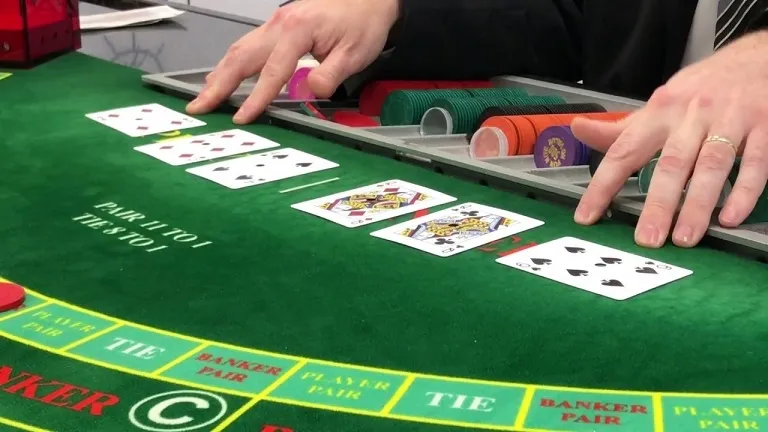
Baccarat is the simplest table game in the casino. Two hands are dealt — the "Banker" hand and the "Player" hand. Whichever hand totals closer to 9 wins. Players bet on which hand will win (or on a Tie). That's the entire game. Unlike blackjack, players make no strategic decisions during the hand — the cards are dealt according to fixed rules, totals are revealed, and bets are settled.
The terms "Banker" and "Player" are just labels for the two hands. You can bet on either, regardless of where you sit at the table. The Banker bet has slightly better math (1.06% house edge) than the Player bet (1.24%) — that small math edge is the foundation of every serious baccarat strategy.

Card Values and Hand Totaling Rules
Card values in baccarat differ from blackjack:
| Card | Value |
|---|---|
| 2 through 9 | Face value (2-9) |
| 10, Jack, Queen, King | 0 |
| Ace | 1 |
The "Drop the Tens" Totaling Rule
Hand totals in baccarat work differently from any other casino game. If a hand's total exceeds 9, you drop the tens digit. So:
- 7 8 = 15 → hand total is 5 (drop the 1)
- 9 7 = 16 → hand total is 6 (drop the 1)
- 5 5 = 10 → hand total is 0 (drop the 1)
- 4 4 = 8 → hand total is 8 (no drop needed)
This rule sounds odd at first but takes 5 minutes to internalise. After that, you read hand totals instantly. The highest possible hand is 9 (called a "natural nine" if dealt on the first two cards), which is unbeatable.
Standard Gameplay Flow
- Players place bets on Banker, Player, or Tie (and any optional side bets).
- Dealer deals two cards each to Banker and Player hands. All cards are face-up.
- Hand totals are calculated using the "drop the tens" rule.
- If either hand has a "natural" 8 or 9, both hands stand and the round resolves immediately.
- Otherwise, the third card drawing rules apply (covered in next section).
- Final totals are compared. Higher total wins. Same total = Tie.
- Bets are paid: Banker wins pay 0.95:1 (1:1 minus 5% commission); Player wins pay 1:1; Tie wins pay 8:1.
Third Card Drawing Rules
The most "complicated" part of baccarat is the third card drawing rules — but you don't need to memorise them as a player. The dealer handles all third card decisions automatically based on fixed rules. The rules exist to mathematically optimise the game; you simply watch them unfold.
Player Hand Third Card Rule
- If Player total is 0-5: Player draws a third card.
- If Player total is 6-7: Player stands.
- If Player total is 8-9: Natural — both hands stand.
Banker Hand Third Card Rule
Banker third card rules depend on what Player did:
- If Player stood, Banker uses Player rules (draw on 0-5, stand on 6-7).
- If Player drew, Banker draws based on Banker's current total and Player's drawn card — complex table-based decision the dealer handles.
For practical purposes: you don't need to know the third card rules to play baccarat correctly. The dealer handles every decision automatically. Just place your bet, watch the cards, and collect or lose based on the final totals.

The Three Main Bets — Banker, Player, Tie
| Bet | Payout | House Edge | Recommendation |
|---|---|---|---|
| Banker | 1:1 minus 5% commission (0.95:1) | 1.06% | ★★★★★ Default bet |
| Player | 1:1 | 1.24% | ★★★★ Acceptable alternative |
| Tie | 8:1 (some tables 9:1) | 14.36% (8:1) | ✗ Never bet |
Why Banker Has the Best Math
Banker wins slightly more often than Player due to the third-card drawing rules favouring Banker. The casino charges a 5% commission on Banker wins to compensate for this advantage, but even after the commission, Banker's house edge of 1.06% is lower than Player's 1.24%.
Why Tie Is the Worst Bet
The 14.36% house edge on Tie at 8:1 payout (or 4.85% at the rare 9:1 payout) is dramatically worse than Banker or Player. Tie bets look attractive because of the high payout multiplier, but the math is structurally bad. Skip Tie bets every time.
Payouts and the 5% Commission
Most baccarat tables charge a 5% commission on Banker wins. This means a RM 100 Banker bet that wins returns RM 195 total (RM 95 profit RM 100 stake) instead of the standard RM 200 (1:1 payout).
Commission-Free Baccarat (Niche Variant)
Some tables offer "Commission-Free Baccarat" where Banker wins pay 1:1 (no commission). The catch: when Banker wins with a total of 6, the payout is reduced to 0.5:1 instead of 1:1. The math works out to a slightly worse house edge than standard 5% commission baccarat. Stick to standard commission baccarat as your default.
EZ Baccarat / Commission-Free Variants
EZ Baccarat similarly eliminates the commission but adjusts payouts on specific results (Banker 7 with 3 cards is a Push). Math is comparable to standard baccarat. Available on some Malaysian-facing operators but standard baccarat remains the dominant variant.
Side Bets to Avoid — Pair, Big/Small, Dragon Bonus
Most baccarat tables offer optional side bets with much higher house edges than the main bets. The five-rule guide: skip them all.
| Side Bet | House Edge | Recommendation |
|---|---|---|
| Player Pair / Banker Pair | 10.36% | ✗ Skip |
| Big (5-6 cards dealt) | 4.35% | ✗ Skip |
| Small (4 cards dealt) | 5.27% | ✗ Skip |
| Dragon Bonus | 2.65-9.37% | ✗ Skip |
| Lucky Six / Super Six | 2.7-29% | ✗ Skip |
All baccarat side bets carry house edges meaningfully worse than the main Banker bet (1.06%). The only reason to take side bets is variance preference and entertainment — not expected value. Disciplined baccarat play stays on Banker, occasionally Player, and skips side bets entirely.
Baccarat Myths Busted
5 Baccarat Myths to Drop in 2026
- "Scorecards predict the next hand." Every baccarat hand is statistically independent. Past results have zero predictive value for future hands. The scorecard is entertainment, not strategy.
- "Betting patterns can beat baccarat." No betting system changes the house edge. Martingale, Fibonacci, D'Alembert — they redistribute variance but produce identical long-run results.
- "Streak betting captures momentum." Same independence math. A 10-Banker streak does not increase the probability of an 11th Banker win — the next hand is still ~50/50.
- "Switching tables resets your luck." The dealer, shoe, or table doesn't track your individual betting history. Identical math everywhere.
- "Tie bets sometimes have value." Tie's 14.36% house edge is structural. The 8:1 payout looks attractive but doesn't compensate for the rarity of the outcome. Never bet Tie.
Frequently Asked Questions About Baccarat Rules Malaysia 2026
What is the house edge in baccarat?
Banker bet: 1.06% (the lowest house edge in any major casino game). Player bet: 1.24%. Tie bet: 14.36% (or 4.85% on rare 9:1 payout tables). Default to Banker for the best long-run math.
Why is Banker the best bet in baccarat?
Banker wins slightly more often than Player due to the third-card drawing rules favouring Banker. The casino charges a 5% commission on Banker wins to compensate, but even after commission, Banker's 1.06% house edge is lower than Player's 1.24%. For optimal long-run math, always bet Banker.
Should I ever bet on Tie?
No. Tie bets carry a 14.36% house edge — dramatically worse than Banker or Player. The 8:1 payout looks attractive but doesn't compensate for the rarity of the outcome. Tie bets are the single worst bet on the baccarat table.
Are baccarat scorecards useful?
No. The "Big Road," "Bead Road," and other scorecards displayed at baccarat tables are entertainment, not strategy. Every hand is statistically independent — past results have zero predictive value for future hands. Watching the scorecard is fine; betting based on it has no mathematical advantage.
Can I count cards in baccarat?
Practically no. Card counting techniques exist for baccarat but the achievable edge is microscopic (under 0.1%) and only emerges at extreme deck penetration — conditions that don't exist on modern live baccarat tables. Basic Banker betting captures 99% of available player edge without counting.
Is live dealer baccarat better than RNG baccarat?
The math (house edge) is identical on properly licensed games. Live dealer baccarat offers physical verifiability and atmosphere; RNG baccarat offers faster pacing and lower minimum bets. For pure return optimisation, both work equally well. Most Malaysian players prefer live dealer for the experience and the visible card-handling.
Can I claim the welcome bonus playing baccarat?
Yes — the Live Casino 100% Welcome Bonus applies to live baccarat tables. Note that baccarat contributes 10-20% to bonus wagering (versus 100% for slots), so wagering clearance takes longer. Plan session volume accordingly. Full terms on the Promotion page.
Why VVCasino Offers Malaysia's Best Live Baccarat Tables in 2026
VVCasino — the premier live casino Malaysia destination — runs baccarat tables from Evolution Gaming (industry standard), Pragmatic Play Live (mobile-first), SA Gaming (Asian dealer focus), and Asia Gaming Live. Standard 5% commission baccarat at minimum bets from RM 5. Full baccarat hub with Speed Baccarat, Lightning Baccarat, Baccarat Squeeze, and Dragon Tiger variants. Beyond baccarat, 250 total live dealer tables at the Live Casino Malaysia hub, 1,500 slots via our Online Slots Malaysia hub, and full sportsbook coverage at the Sports Malaysia hub.
For related reading, see How to Play Baccarat, How to Win Baccarat, Blackjack Rules, How to Play Blackjack, Roulette Rules, and How to Play Roulette.
1.06% House Edge. The Lowest in the Casino.
Live baccarat with Evolution Gaming, Pragmatic Play, SA Gaming, Asia Gaming. RM 5 minimum bets on standard tables. MYR 2,880 welcome bonus. Register on Malaysia's leading live casino today.
Register & Play Baccarat Browse Baccarat Tables