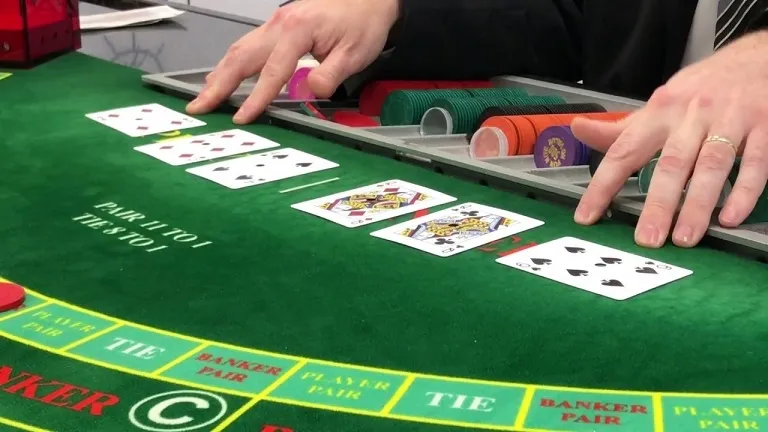
Baccarat Rules
Baccarat, often associated with high rollers and the glamour of secret agents, is fundamentally one of the simplest and most statistically favorable casino table games. Unlike Blackjack, where players make critical decisions after the cards are dealt, Baccarat (specifically the dominant version, Punto Banco) is a game of chance once bets are placed. The dealer follows strict, fixed Baccarat rules (or tableau) that determine if a third card is drawn, meaning the player's only choice is where to place their wager. This comprehensive guide dissects the rules of Baccarat, explains card values, clarifies the complex third card rules, analyzes the three main betting options, and details the statistical house edge that makes this game a staple in both land-based casino and live dealer casino environments. Mastering these rules is key to enjoying this elegant and fast-paced game.
The Objective and Core Card Values in Baccarat
The objective of Baccarat is straightforward: to bet on which of two hands—the Player or the Banker—will achieve a total point value closest to nine (9). The game is typically played with six to eight decks of cards shuffled together.
Card Values
The value of the cards is fixed and non-negotiable:

-
Aces: Count as 1 point.
-
Cards 2 through 9: Count as their face value (pip count).
-
Tens and Face Cards (J, Q, K): Count as 0 points (also known as Baccarat).
Hand Totals
Hand totals are calculated by summing the card values. If the total is a two-digit number, only the second digit is counted as the hand's value.
-
Example 1: A hand of 7 6 totals 13, so the value is 3.
-
Example 2: A hand of King (0) 5 totals 5, so the value is 5.
-
Example 3: A hand of 9 Ace (1) totals 10, so the value is 0. All hand totals range from 0 to 9.
The Betting Options and Payout Structure

Before any cards are dealt, players must place their initial bets on one of three main outcomes: Player, Banker, or Tie. Understanding the statistical advantage of each bet is fundamental to Baccarat strategy.
Banker Bet
-
Payout: 1:1 (Even money).
-
Commission: A 5% commission (or vigorish) is charged on all winning Banker bets. This commission is collected by the casino because the Banker hand has a slightly higher statistical chance of winning due to the third card rules.
-
House Edge: Approximately 1.06% (the lowest in the game, making it the most statistically sound bet).
Player Bet
-
Payout: 1:1 (Even money).
-
Commission: No commission is charged on winning Player bets.
-
House Edge: Approximately 1.24% (still very low compared to most other casino games).
Tie Bet
-
Payout: Typically 8:1 (though some tables may pay 9:1).
-
Outcome: The bet wins if the Player and Banker hands have the same total value.
-
House Edge: Approximately 14.36% (the highest house edge, making it the least favorable bet for long-term profit). If a Tie occurs and a player did not bet on the Tie, their Banker or Player bets are considered a Push, and the stake is returned.
The Dealing Process and the "Natural" Win
After all wagers are placed, the dealer deals two cards face up to both the Player hand and the Banker hand. The cards are dealt alternately: Player, Banker, Player, Banker. The process is strictly governed by the house:
The Natural Win
If either the Player hand or the Banker hand achieves a total of 8 or 9 with the first two cards, this is called a Natural. The hand with the Natural wins immediately, and no further cards are drawn.
-
A Natural 9 beats a Natural 8.
-
If both hands have the same Natural total (e.g., both 8), it is a Tie.
The Player Hand Third Card Rule (Tableau)
If neither hand has a Natural, the game proceeds to determine if a third card should be dealt. Crucially, the Player hand always acts first, and its decision is entirely automatic, dictated by the fixed rules:
| Player’s Two-Card Total | Action |
| 0, 1, 2, 3, 4, 5 | Draw a third card. |
| 6 or 7 | Stand (no third card drawn). |
| 8 or 9 | Natural (Stand, no third card dealt to either hand). |
If the Player stands on a 6 or 7, the Banker hand proceeds according to a simpler set of rules, as detailed below.
The Banker Hand Third Card Rule: The Complex Crux of the Game
The rules governing the Banker hand's action are more complex because the Banker's decision to draw a third card often depends on what card the Player drew (if the Player drew one). Despite the complexity, these rules are automatic and followed by the dealer in all standard games like Punto Banco or Mini Baccarat. Players do not need to memorize them, but understanding the logic explains the Banker's statistical advantage.
Banker Action When Player Stands (Player Hand Totaled 6 or 7)
If the Player stands (totaling 6 or 7 with two cards), the Banker follows these simple rules:
-
Banker Total 0-5: Banker Draws a third card.
-
Banker Total 6 or 7: Banker Stands.
-
Banker Total 8 or 9: Banker Stands (Natural).
Banker Action When Player Draws a Third Card (Player Hand Totaled 0-5)
If the Player draws a third card, the Banker's actions are dependent on the Banker's two-card total and the rank of the Player's third card. This is the most complex part of the Baccarat rules:
| Banker's Two-Card Total | Banker Action (Draws if Player's Third Card Is...) | Banker Action (Stands if Player's Third Card Is...) |
| 0, 1, 2 | Always Draws (unless Player has Natural 8/9). | (None) |
| 3 | 0, 1, 2, 3, 4, 5, 6, 7, 9 | 8 |
| 4 | 2, 3, 4, 5, 6, 7 | 0, 1, 8, 9 |
| 5 | 4, 5, 6, 7 | 0, 1, 2, 3, 8, 9 |
| 6 | 6, 7 | 0, 1, 2, 3, 4, 5, 8, 9 |
| 7 | Stands | (None) |
| 8, 9 | Stands (Natural) | (None) |
After all cards have been dealt (neither hand will ever have more than three cards), the hand closest to 9 wins.
The Statistical Advantage: House Edge and Betting Strategy
The primary reason the Banker bet has the lowest house edge (1.06%) is precisely because the Banker acts after the Player and adjusts its draw decision based on the Player's final hand (specifically the Player's third card). This slight positional advantage is enough to give the Banker a win probability of approximately 45.86%, compared to 44.62% for the Player. The casino neutralizes this slight advantage by charging the 5% commission on winning Banker bets.
Optimal Baccarat Strategy
For all practical purposes, the optimal Baccarat strategy is purely a bankroll management and betting decision: always bet on the Banker. While the Player bet is close (1.24% house edge), the Banker remains the most statistically sound wager. The Tie bet should be avoided for serious play due to its extremely high house edge of 14.36%.
Baccarat Variations and Modern Play
No Commission Baccarat (Super 6)
This popular variation removes the 5% commission on winning Banker bets for simplicity and speed. To maintain the house edge, a winning Banker hand that totals 6 is typically paid at 1:2 (half the original bet) instead of 1:1. This subtle rule change shifts the house edge on the Banker to around 1.46%, which is actually slightly worse than the traditional commission game, though still better than the Tie bet.
EZ Baccarat
Similar to No Commission Baccarat, EZ Baccarat also removes the commission. However, instead of reducing the payout on a Banker 6, it makes the Banker win with a three-card total of 7 a Push (tie). This gives the Banker hand an even lower house edge of 1.02%. EZ Baccarat often includes popular side bets like the Dragon 7 (Banker wins with a three-card 7, paying 40:1) and the Panda 8 (Player wins with a three-card 8, paying 25:1).
Chemin de Fer and Baccarat Banque
These older, European versions involve player skill and rotation of the Banker role. In Chemin de Fer, players have a choice on whether to draw a third card when their total is 5, making it a game of skill and social interaction, unlike the fixed rules of Punto Banco. However, in online casino and general land-based casino play outside of high-limit rooms, Punto Banco and its variations dominate.
Baccarat in the Online and Live Dealer Environment
The simplicity of the rules makes Baccarat an ideal game for the online gambling sphere. Live dealer Baccarat tables, often featuring Baccarat Squeeze or Speed Baccarat, have become hugely popular, offering an immersive experience with real cards and professional croupiers. The dealer handles all third card rules and payouts automatically, allowing the player to focus purely on the next betting decision and their bankroll management.
FAQ
The three main options are Banker (lowest house edge at 1.06%), Player (house edge at 1.24%), and Tie (highest house edge at 14.36%). The Banker bet is the most statistically advantageous, even with the 5% commission charged on winning hands.
A Natural is a hand total of 8 or 9 achieved with the first two cards dealt to either the Player or the Banker. If a Natural is dealt to either hand, the round immediately ends, and no third card is drawn.
In the dominant version of Baccarat (Punto Banco or Mini Baccarat), the player has no strategic decisions to make after the initial bet is placed. The Baccarat rules (or tableau) for drawing a third card are fixed and automatic for both the Player and Banker hands, determined entirely by the existing hand totals.
The 5% commission is charged to offset the Banker's slight statistical advantage. Due to the fixed third card rules, the Banker hand wins slightly more often than the Player hand (45.86% vs. 44.62%), and the commission is the casino's way of building its necessary house edge.
The Tie bet is unfavorable because its payout (typically 8:1) does not accurately reflect the actual low probability of a tie occurring. The probability of a tie is only about 9.5%, resulting in a very high house edge of 14.36%, making it a poor choice for long-term profit.
Cards 2 through 9 are worth their face value, Aces are 1 point, and 10s/Face Cards are 0 points. If the total sum of the cards is a two-digit number, the value of the hand is the second digit. For example, a total of 17 becomes 7, and a total of 10 becomes 0.
The Player hand must draw a third card if its initial two-card total is between 0 and 5. The Player hand must stand if the initial two-card total is 6 or 7. This rule is applied before the Banker's turn.
The Banker's decision is conditional only if the Player draws a third card (i.e., the Player started with 0-5). The Banker's drawing rule (draw or stand) is then determined by the Banker's two-card total combined with the specific value of the Player's third card, as outlined in the tableau rules.
No Commission Baccarat eliminates the 5% commission on winning Banker bets to simplify play. However, to compensate the casino, if the Banker wins with a total of 6, the payout is reduced to 1:2 (half the original wager).
Baccarat is statistically favorable because the Banker and Player bets have two of the lowest house edges found in any casino table game, sitting around 1.06% and 1.24% respectively. This low margin ensures a high Return to Player (RTP) compared to games like Roulette or Slots.